Dynamic DCA System
High-Level Breakdown of Our Sophisticated Dollar-Cost Averaging Strategy
Performance Dashboard
Real-time metrics from our Dynamic DCA System
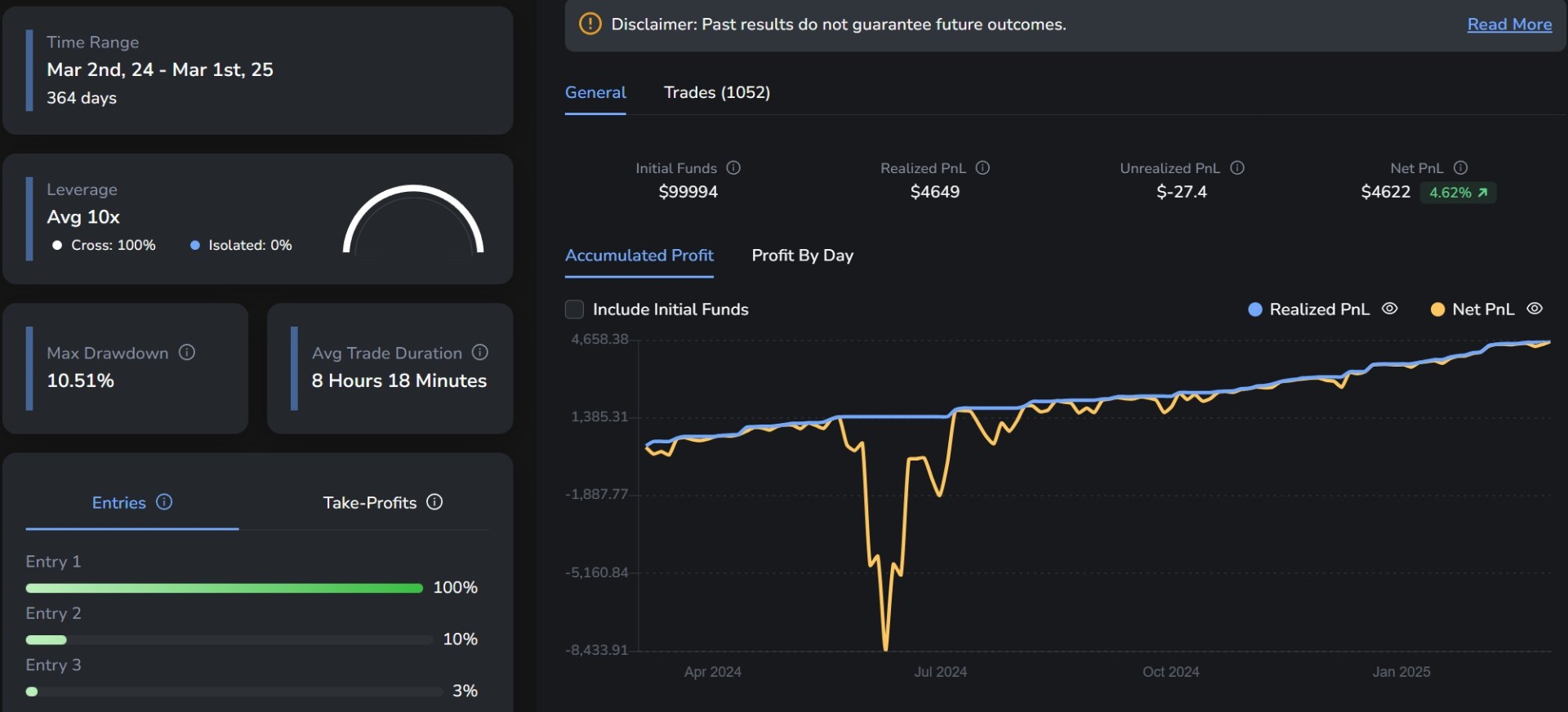
The dashboard displays key performance metrics including: initial funds of $99,994, realised profit of $4,649, maximum drawdown of 10.51% and average trade duration of 8 hours 18 minutes.
Dynamic DCA System — Core Strategy
Your DCA system is adaptive, risk-aware and systematically de-risking — not a blind averaging strategy.
1Micro-Entry Anchoring (Initial Trigger)
- The first order is extremely small, a fractional probe into the market.
- It's designed to catch micro-moves, with a tight TP window.
- If TP hits, the cycle ends early — quick scalp, minimal risk.
2Adaptive Scaling (ATR-Based)
- If price continues against the initial entry, the system refers to ATR-based thresholds to structure additional DCA levels.
- These do not enter all at once — they trail price behaviour with conditional logic.
- No full martingale. It's conservative and only builds if structure or mean-reversion risk premium is identified.
3Exit Strategy – Limit-Only Execution
- Limit-order exits constrain the acceptable price but may remain unfilled.
- A single market stop exists as a safety net — it's a dynamic trailing stop that activates only in price rebounds or failure to mean-revert.
- Stop execution and liquidation risk depend on available liquidity, margin and venue operation.
4Constant De-Risking & System Reset
- Once a cycle is closed, the system resets, recalibrating ATR, structure and behaviour.
- Exits are managed around the average entry; positive expectancy must be established from net results.
- The system doesn't "hold and hope" — it's always managing exit windows.
Overlay System — Risk Management & Adaptive Structuring
Enhanced performance through strategic overlays that complement the core DCA strategy
1DCA System (Core)
Remains live throughout, managing long/short exposure without overextension. No trades are force-closed; we let the structure work as designed for optimal capital efficiency.
2Signal Shorting/Longing (Manual)
Opportunistic shorts or longs in BTC and ETH are executed manually using the same principles as the DCA engine. These capture key directional moves with controlled size and risk parameters.
3Hedge Mode & Terminal-Level Hedging (System 2.5)
Hedging allows us to hold directional bias without closing trades. We dynamically hedge open longs or shorts, buying time and improving capital efficiency across the entire portfolio. Hedging is now standard.
Note: The overlay system works in tandem with the core DCA strategy, providing additional layers of risk management and capitalising on market opportunities while maintaining the disciplined approach of the base system.
Flow-Governed Systematic Trading: A Unique Approach
Understanding our sophisticated systematic trading methodology
1Flow-Governed Trading Methodology
High-Frequency Flow-Governed Trading
- High-frequency execution with 486+ trades weekly
- Rapid entries and exits often within minutes
- Focused on BTC and ETH
- Strict stop-loss management with 0.68-0.79% profit targets
- 99.87% win rate with no observed liquidations
- Balanced long and short position execution
- Flow-based decision making and position sizing
2The Flow Overlay System Explained
The high-frequency flow overlay system delivers algorithmic precision with strategic flow analysis, executing rapid trades across diversified crypto portfolios whilst maintaining disciplined risk management with consistent profit targets and zero liquidations.
Performance Verified: Our High-Frequency Flow-Governed Trading achieves 99.87% win rate through disciplined execution across 20+ cryptocurrencies, with 486+ weekly trades and consistent 0.68-0.79% profit targets, delivering systematic returns with zero liquidations.
This DCA system isn't passive — it's a living, risk-adjusted mechanism with decision gates and layered logic. The kind of setup that thrives in volatile conditions while protecting capital against tail risk.
DCA System FAQ
Common questions about our dynamic dollar-cost averaging strategy
Is this ordinary scheduled spot buying?
No. This page describes a trading-cycle approach with small initial entries, ATR-based additional levels and managed exits, alongside separately described hedging and discretionary overlays. It should not be confused with a passive BTC or ETH savings plan.
How are entries and exits controlled?
The described design uses conditional entries, volatility-based spacing and limit-order exits, with additional risk controls. Limit orders constrain the acceptable price but may not fill; market or stop orders can incur slippage. Neither approach guarantees a profitable exit.
Can I change the parameters?
Discuss sizing, spacing, exposure limits and permitted overlays before the configuration is approved. Mid-cycle changes can alter margin and exit behaviour; they should be coordinated with the operator rather than changed independently.
Is the October hedge-only study the same as this system?
No. The October 2026 study proposes paired hedge bots plus cash reserves and excludes standalone directional grids and swing positions. Historical results from a mixed DCA and overlay book do not establish the performance of that hedge-only mandate.
Ready to optimise your investment strategy?
Get in touch to discuss how our algorithmic trading system can help maximise your returns.